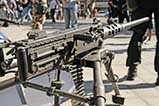
That dollar figure results from a 57% gain from $443.1 million 5 years earlier in 2020.
Year over year, overall spending on that military weaponry accelerated by 41.7% compared to $490.8 million starting from 2023.
The 5 biggest exporters of non-artillery military weapons are the United States of America, Belgium, United Kingdom, Poland and Canada. Combined, that quintet of leading international suppliers accounted for 89% of globally exported military weapons studied in this article. Such a high percentage indicates a concentrated cohort of weaponry exporters.
Applying a continental lens, suppliers in Europe shipped the highest value of non-artillery military weapons at $333.3 million or 47.9% of worldwide exports for this commodity subcategory. In second place were sellers in North America at 47.2% trailed by those in Asia (3.2%) and Oceania’s Australia and Fiji (0.7%).
Smaller percentages came from providers in Latin America (0.55%) excluding Mexico but including the Caribbean, and competitors in Africa (0.54%).
For research purposes, the 6-digit Harmonized Tariff System code prefix for military weapons is 930190. (That prefix covers sub-machine guns but excludes artillery weapons like rocket launchers and flame-throwers).
Top Military Weapons Exporters
Below are the 15 countries that exported the highest dollar value worth of military weapons (excluding artillery products such as rocket launchers and flame-throwers) during 2024.
- United States: US$304.4 million (43.8% of exported non-artillery military weapons)
- Belgium: $146.8 million (21.1%)
- United Kingdom: $114.1 million (16.4%)
- Poland: $30 million (4.3%)
- Canada: $23.8 million (3.4%)
- Indonesia: $19.3 million (2.8%)
- Switzerland: $14.1 million (2%)
- Slovakia: $8 million (1.1%)
- Croatia: $7.2 million (1%)
- Romania: $4.4 million (0.6%)
- Australia: $3.5 million (0.5%)
- Colombia: $2.9 million (0.4%)
- Spain: $2.6 million (0.4%)
- Netherlands: $2.3 million (0.3%)
- Portugal: $2.2 million (0.3%)
By value, the listed 15 countries shipped 98.5% of all non-artillery military weapons exported in 2024.
Among the top suppliers, the fastest-growing exporters of non-artillery military weapons since 2023 were: Spain (up 627%), Indonesia (up 566.5%), Croatia (up 544.7%) and the United Kingdom (up 210.3%).
Major suppliers that posted declines in their international sales of non-artillery military weapons were: Slovakia (down -64.1% from 2023), Canada (down -59.9%), Portugal (down -19.8%) and the Netherlands (down -1.2%).
Countries Earning Best Trade Surpluses from Military Weapons
The following countries posted the highest positive net exports for non-artillery military weapons during 2024. Investopedia defines net exports as the value of a country’s total exports minus the value of its total imports. Thus, the statistics below present the surplus between the value of each country’s exports of non-artillery military weapons and its import purchases for that same commodity.
- United States: US$295.4 million (net export surplus up 44.1% from 2023)
- Belgium: $143.6 million (up 70.5%)
- Canada: $21.7 million (down -61.1%)
- Switzerland: $14.1 million (up 28.4%)
- United Kingdom: $13.1 million (reversing a -$62.5 million deficit)
- Croatia: $3.1 million (up 177.1%)
- Slovakia: $2.4 million (down -67.7%)
- Portugal: $2.2 million (down -20.3%)
- Poland: $2 million (down -28.6%)
- Egypt: $1.1 million (down -12.4%)
- Montenegro: $993,000 (up 1705.5%)
- Chile: $954,000 (up 90%)
- Spain: $335,000 (reversing a -$5.7 million deficit)
- Sri Lanka: $29,000 (down -150.9%)
- Russia: $25,000 (down -50%)
The United States of America generated the highest surplus in the international trade of military weapons. In turn, this positive cashflow confirms America’s strong competitive advantage for this specific product category.
Countries Causing Largest Trade Deficits from Military Weapons
The following countries posted the highest negative net exports for non-artillery military weapons during 2024. Investopedia defines net exports as the value of a country’s total exports minus the value of its total imports. Thus, the statistics below present the deficit between the value of each country’s imported non-artillery military weapons purchases and its exports for that same commodity.
- Nigeria: -US$332.1 million (net export deficit up 5345.9% from 2023)
- Indonesia: -$53.7 million (up 5.9%)
- Netherlands: -$23.9 million (reversing a $677,000 surplus)
- Jordan: -$17.7 million (2023 data unavailable)
- Philippines: -$16 million (up 111.8%)
- Australia: -$14.4 million (up 78.1%)
- Brazil: -$11.9 million (down -54.6%)
- Angola: -$10.4 million (2023 data unavailable)
- Estonia: -$9.2 million (up 726.7%)
- Democratic Republic Congo: -$7.3 million (2023 data unavailable)
- Maldives: -$7.1 million (up 8469.9%)
- Norway: -$7 million (down -29%)
- Lithuania: -$6.5 million (up 348.7%)
- Romania: -$6.1 million (2023 data unavailable)
- Rwanda: -$5.8 million (up 4956.5%)
Overtaking the United Kingdom, Nigeria incurred the highest deficit in the international trade of non-artillery military weapons. In turn, this negative cashflow highlights Nigeria’s competitive disadvantage for this specific product category but also signals opportunities for non-artillery military weapons-supplying countries that help satisfy the powerful demand.
See also Aerospace Exports by Country, Top Industrial Robots Exporters and Top Fireworks Exporters
Research Sources:
Central Intelligence Agency, The World Factbook Field Listing: Exports – Commodities. Accessed on January 5, 2026
Forbes Global 2000 rankings, The World’s Biggest Public Companies. Accessed on January 5, 2026
International Trade Centre, Trade Map. Accessed on January 5, 2026
Investopedia, Net Exports Definition. Accessed on January 5, 2026